

Views shared by Summit speakers and participants are their own and may not reflect the positions of their organizations.
For about 20 years before joining Hallmark, I managed physician/APC (clinician) compensation, contracts, data analytics, and recruitment at large health systems. What I learned in that time is that a compensation plan exists to influence and reward behavior. When the way healthcare organizations deliver care changes, our pay models must change with it.
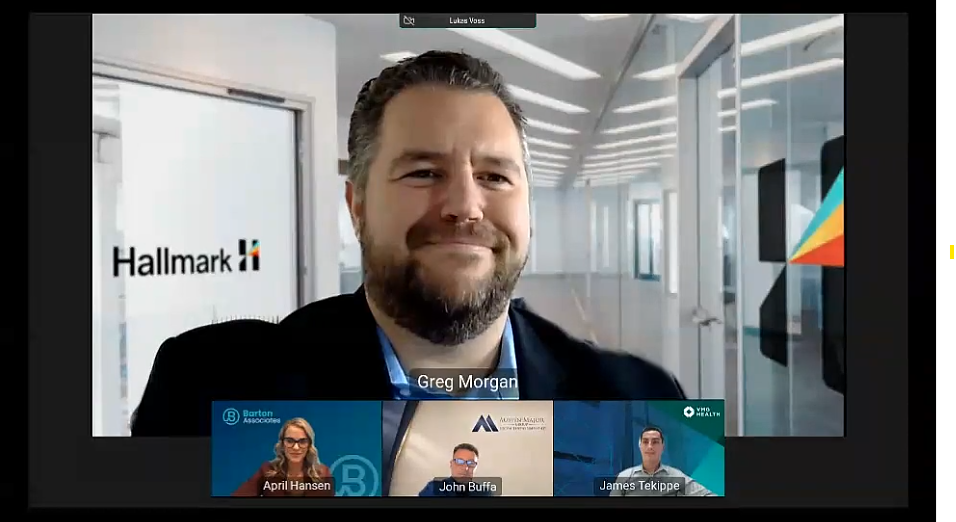
On September 17, 2026, Hallmark hosted its Workforce Innovation Summit in Plano, Texas. I spent the day primarily in the Physician Enterprise track and participated in three sessions focused on team-based care, benchmarking, and access.
In this post, I’ll walk through each discussion and what it means to me as someone who has worked through many of these same challenges.
We’re asking physicians, APCs, and staff to work together more closely than they used to. For those of us who design clinician compensation models, that raises a question: how do we build pay structures that support that teamwork? That was the focus of the morning roundtable I co-hosted with Kandis Porter, Founder and CEO, Effective Flow Connections, for leaders who manage clinician compensation for major health systems. A quick show of hands showed that team-based pay structures are now common, and many include both physicians and APCs.
Primary care, psychiatry, and hospital-based groups such as hospitalists and intensivists were named as natural fits. Attribution was more difficult. In one OBGYN group, the delivering clinician receives all of the delivery wRVUs where another organization splits them 50/50 between the delivering clinician and whoever provided the prenatal care.
We also discussed the level at which to measure performance. Because an inpatient may see several physicians and APCs, one system measures patient experience at the hospital level for inpatient specialties and at the individual level in its outpatient clinics. In my experience, the higher the level of measurement, the weaker its effect on behavior, though it can be considered more “fair” and control for certain factors. Leaders also compared incentive “gates” that must be met before a payout, such as meeting attendance, minimum productivity, session completion, and chart completion.
The second half of the session focused on change management. Kandis stressed that leaders should clearly explain to clinicians why the plan is changing and begin communicating with them earlier than may feel comfortable. Timing is where most organizations struggle: a major redesign usually takes at least 8 to 12 months, but communication may not begin until 6 months in. It should begin much earlier than that, even if specifics cannot yet be shared.
One participant shared a transparency tactic that has also worked well for me: well before go-live, give each clinician a spreadsheet showing the new model’s impact on them, positive or negative. This builds trust and allows discussions with leaders about potential exceptions to happen in advance.
Clinician compensation is often a medical group’s largest expense, and many health systems set it using national salary surveys. In the afternoon roundtable “Benchmarking in a Broken Market,” my Hallmark counterpart David Kruse, VP, Physician Enterprise, and Jie Li, VP, Provider Compensation, Millennium Physician Group, explored why that has become harder. Median pay keeps rising while productivity stalls in some specialties, surveys lag the market, and CMS wRVU value changes have made benchmark comparisons more difficult. When David asked whether the latest benchmarks matched leaders’ current markets, the answer was generally no.
For example, CRNA survey data trails a rapidly changing market. Leaders also pointed to APCs and surgeons, whose actual pay often doesn’t line up with survey data, and to pediatric subspecialties, GI, and urology, which are hard to recruit at benchmark pay because their markets change faster than benchmark data is updated. Irrespective of benchmarks, each organization also needs to manage affordability, which is specific to its situation. One academic system pays the lower of the market rate or what a department can afford.
Jie still finds benchmark data useful, but only as a reference rather than something that dictates how clinicians are paid, and said the industry needs smarter data that goes beyond total cash compensation and wRVUs.
The day’s final general session, “The Access Challenge: Aligning Systems to What Matters Most,” started from one premise: access, not individual productivity, is often the main inhibitor to growth. David Kruse moderated, and I joined Amy Strauss, Senior Director, Advisory, Premier Inc., and Kyllan Cody, Founder and Principal Advisor, Cody Executive Advisory, on the panel.
The panel agreed that access challenges are common and solutions need to intimately involve operations and clinician leaders. Frequent causes of access challenges include (i) organizations not identifying what access means, (ii) disconnected systems, (iii) decentralized scheduling templates, and (iv) inpatient demands that take precedence over outpatient availability. No single metric captures access perfectly, and a busy clinic isn’t the same as an accessible one. I prefer clinician schedule utilization paired with patient survey data related to ease of getting an appointment. This combines a quantitative view of access with the patient’s perception of it, which can be equally if not more important, and accounts for practices at different levels of maturity (a new practice ramping up versus an established one). Amy favored new patient ratios and keeping panels open.
We also discussed compensation’s role in driving access. I noted that organizations too often look to compensation as the solution rather than leadership and management interventions (compensation should not be the tail that wags the dog). David correctly noted that individual wRVU incentives already reward churn over access, so pay can’t be left out of the discussion. We landed on coordination: operationalize first, then align compensation and incentives, with clear support from senior leadership. In my experience, schedules may be even more personal to clinicians than pay, and template changes without the department chair’s support are rarely successful nor sustained.
Across these three sessions, the same needs kept coming up. Leaders need (i) pay plans that reward desired behaviors, (ii) market data current enough to be relevant, and (iii) incentives tied to what the organization is trying to achieve, including better access for patients. None of this works without transparency and access to accurate data. Clinicians need to understand how and why they’re paid so they can engage in the work needed to improve performance.
Clinician compensation can’t change at the speed of the care model if every update depends on disjointed spreadsheets. Leaders need a single, connected, and current view of how clinicians are paid, how they’re performing, and how a change will impact each clinician before it is implemented. Hallmark’s Physician Enterprise brings that together. It automates complex plans from contract through payroll, while giving clinicians clear visibility into their pay and performance through a mobile app.
Interested in learning more?
Explore Hallmark’s Physician Enterprise, or request a demo to see how it can bring clarity to your physician compensation from contract to paycheck.