
Views shared by Summit panelists reflect their individual perspectives and do not necessarily represent the views of their organizations.
Before I traded hospital hallways for healthcare technology, I spent 10 years as a Neonatal ICU Charge RN. One thing from those years stays with me: the administrative burden. Too many of my hours (the last four of every shift to be exact) went to phone calls with the house supervisor, who relayed messaging to central staffing, and cold calling staff I trusted would pick up their phones. That burden was real, and for many hospitals, it still is.
Those years still shape how I think about staffing challenges. An operations mindset asks how to fill a shift, while a clinical mindset asks whether it’s the right person, with the right skill set, for the right assignment. I bring that clinical view to my work as VP of Clinical Workforce Strategy at Hallmark, where I help health systems bring the same clinical perspective to how they plan, deploy, and support their workforce.
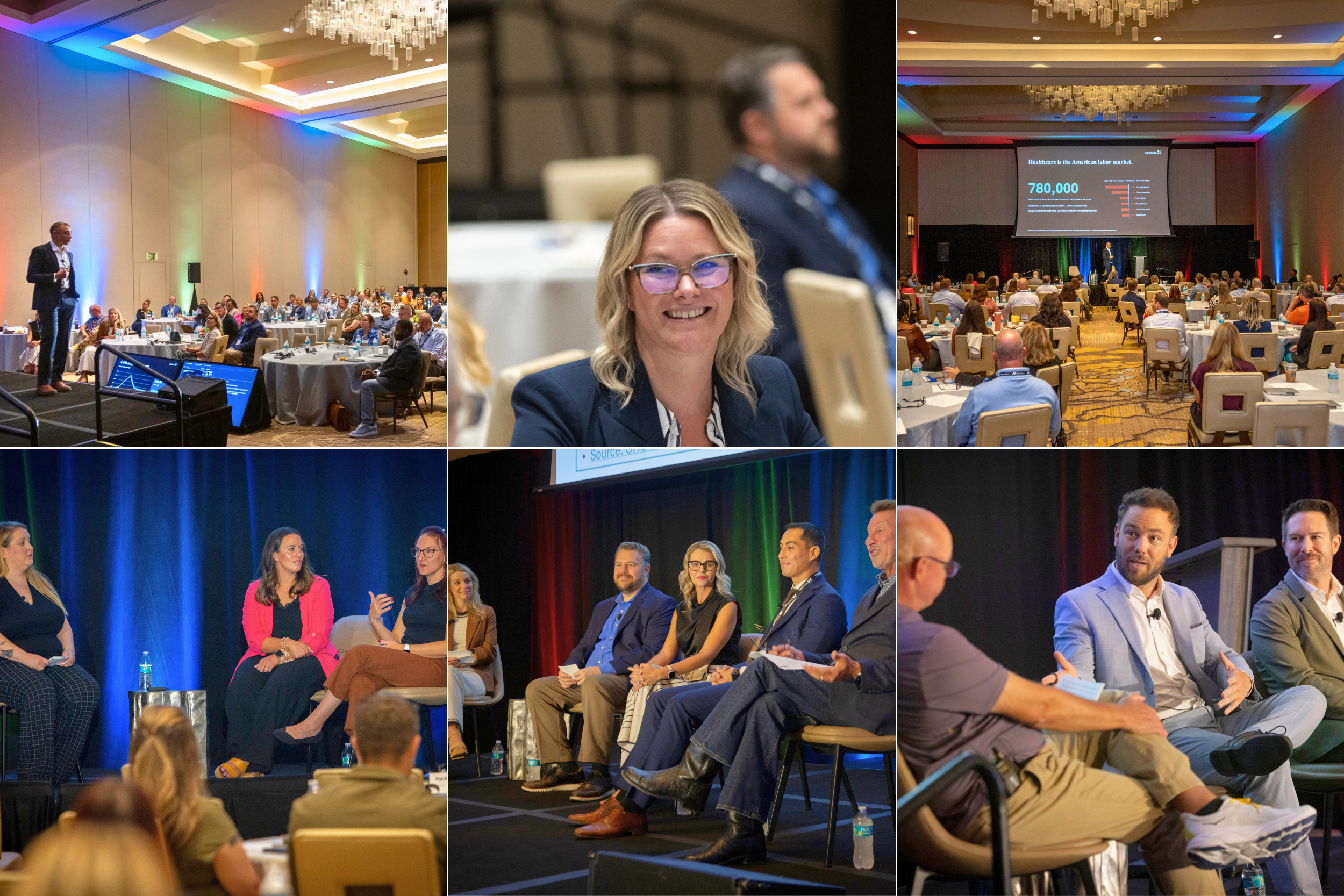
On September 17, Hallmark hosted this year’s Workforce Innovation Summit in Plano, Texas. Every year, the Summit gives us a chance to get the people who run healthcare’s workforce in one room and talk honestly about what’s working, what’s not, and how we can fix it. In this blog, we’ll look at three of the day’s conversations and what they mean from my perspective as a nurse.
In the morning breakout, Hallmark’s Ally Boggs led a conversation with Nicole Roberson of Trinity Health and Alissa Zimmerman of Mayo Clinic about why flexible staffing has become a culture, technology, and trust problem, not just a scheduling one. Nicole shared what it looks like to build flexibility at scale through Trinity’s float pool, which spans local, regional, and national levels and includes more than 3,000 clinicians.
One of the most important points was about planning. Health systems have never had every clinician in a core, unit-based role, yet most still build their budgets and recruitment plans as if they will. The panel also pushed back on a common fear, that flexible roles pull nurses away from core positions, noting that float pools can feed core roles and help retain clinicians who might otherwise leave the organization altogether. Speakers also discussed how flexibility means more than self-scheduling.
They challenged leaders to consider where clinicians work and what skills they bring, and to question whether the department should always be the starting point for workforce planning.
That conversation hit close to home for me. Nurses don’t burn out because the job is busy, since every nurse already knows it’s a busy job. They burn out because they don’t have control over their schedules or limited predictability in their lives. Real flexibility has to address that, and it has to come with support. I’ve spoken with many nurses who were floating to units outside their comfort zone with little to no preparation. Physically, that can mean walking onto a floor where you don’t know where supplies are kept, how the equipment works, or what the unit’s routines look like. Mentally, it means carrying the stress of caring for patients you may not feel ready for, often without a familiar face to turn to. The panel described what better support looks like, including dedicated leaders for float staff, advisory councils that give float resources a voice, and the same training and competencies as core staff.
The same questions are showing up on the provider side, with added complexity. A general session brought together Hallmark’s Greg Morgan and Megan Seiple with April Hansen of Barton Associates, John Buffa of Austin Major Group, and James Tekippe of VMG Health to look at provider staffing from the perspectives of the healthcare organization, the consultant, and the staffing agency.
The panel was clear that recruiting is only part of the problem. Organizations can hire large numbers of physicians and APCs each year and still struggle to grow if they can’t keep them, and panelists pointed to a loss of autonomy as a growing reason clinicians leave. Locums coverage brings its own friction, since interviews, contracts, credentialing, licensing, and privileging all have to line up before a clinician can start. When a placement falls through, the pressure often lands on employed providers who are already stretched, feeding a cycle of burnout and turnover. And because of how physician and APC contracting and compensation are regulated, the flexible models that work well in nursing are much harder to build.
What stands out to me is how familiar these challenges are and how far they reach. The need for flexibility, predictability, and support extends well beyond nursing and allied health. Whether it’s nurses, technicians, or physicians, many health systems are still planning around the workforce they used to have instead of the one they have today. Closing that gap starts with seeing the full enterprise picture.
That’s what the afternoon breakout explored. Hallmark’s Tim Cagney moderated a conversation with Tyler French of UC Health and Jon Stabbe of Community Health System. UC Health built its program directly with staffing agencies before centralizing, while Community Health System moved from an MSP model. Despite those different starting points, the challenges they described were remarkably similar. Contract staffing grew faster than their processes could handle, and neither organization had the visibility it needed into its contract workforce.
The panel shared what made centralization work, including technology like Hallmark’s VMS that allows teams to effectively manage contingent talent on one platform. They also stressed that the goal was never to eliminate contract labor, but to use it deliberately. Once leaders could see their full workforce spanning both internal and external resources, they could ask better questions, like why one unit relies so heavily on contract staff or whether a long-tenured traveler should be offered a permanent role.
The problems they set out to solve are the same ones I lived through as a Charge RN. When no one has a full view of the workforce, finding coverage falls to whomever is holding the phone, and on many shifts that was me. I’d be calling the house supervisor, waiting to hear back from my own staff as well as central staffing, and trying to keep the unit running smoothly at the same time. Technology makes that visibility possible, and that brings up one of the biggest misconceptions I hear: that AI will replace nurse leaders and their clinical judgment. In reality, AI can take on the administrative work and bring forward the best-fit options, with less of the bias that creeps into manual decisions. What it can’t do is know your team. As a leader, I knew the personalities, the dynamics, and who worked well together on a tough night. No algorithm will ever replace that.
A flexible workforce strategy has to get two things right. The first is the people experience, because if staff don’t feel supported and in control of their schedules, the strategy won’t last. The second is operational gain, which comes from using data to forecast demand and having one view of the entire workforce. Getting both right means treating full-time, float pool, contingent, agency, and locums talent as one connected team, looking to internal resources first, and bringing in contract talent by plan, not as a last-minute resort.
That’s the thinking behind Hallmark’s Workforce Operating System. It gives leaders the clarity to plan ahead, offers staff the flexibility and support they’re asking for, and provides health systems the resilience to keep up as demand continues to outpace supply. For the charge nurse who’s down five nurses and wondering who’s going to pick up the phone or respond to a text, that clarity matters most.
Interested in learning more?
Hear more from Jeena on what it takes to build a flexible workforce strategy that lasts in this video. You may also schedule a demo with our team to see how Healthcare’s Workforce Operating System provides you with a unified view of your entire workforce, from float pool and internal resources to agency and locums talent.